

SEO involves a set of techniques and strategies designed to increase the visibility of a website or webpage in organic search results. Unlike paid advertising, SEO focuses on optimizing your site content, technical aspects, site structure, and backlink profile to rank higher without paying for clicks. The ultimate goal? To attract more qualified visitors who are actively searching for information, products, or services that your business offers.
SEO includes on-page optimization (keywords, meta tags, content quality), off-page optimization (backlinks, social signals), and technical SEO (site speed, mobile-friendliness, crawlability). Together these elements signal to search engines that your website is authoritative, relevant, and user-friendly
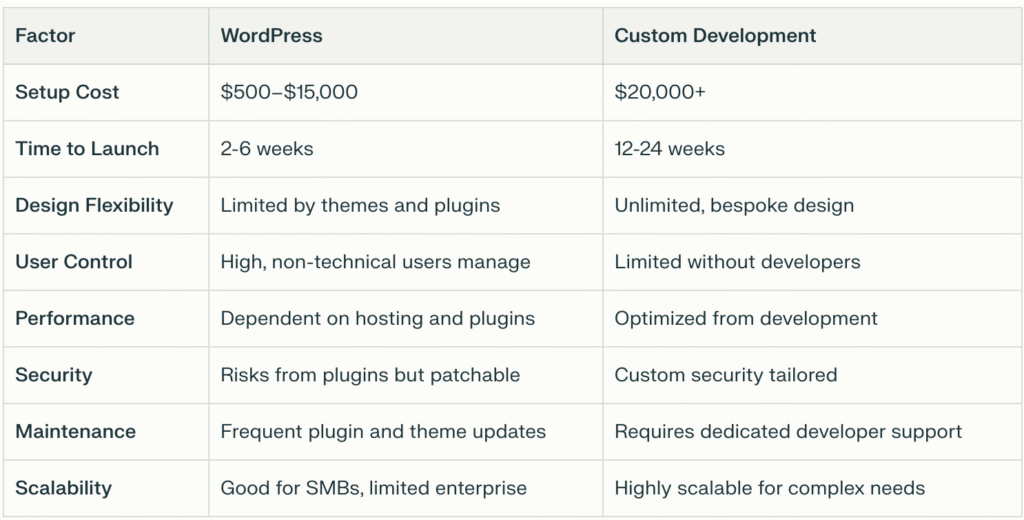
WordPress is the world’s most popular content management system (CMS), powering over 43.4% of all websites globally. Known for its combination of flexibility, affordability, and ease of use, WordPress allows individuals and businesses to build websites quickly using pre-built themes and plugins.
Startups, bloggers, and small to medium-sized businesses (SMBs) that want a quick, budget-friendly website.
Businesses without extensive custom technical needs or complex integrations.
Companies seeking a scalable solution that can grow with added plugins and themes.
Organizations wanting the ability to manage and update website content independently.
Those looking for a vast community for support and continual improvements.
Custom website development involves building a website entirely from scratch, tailored specifically to your exact business requirements, user experience goals, and branding. It requires more upfront investment but delivers complete creative freedom and scalability.
Full Control Over Design & Features: Unlike WordPress themes that require adapting to existing structures, custom sites can have unique, branded interfaces and features as envisioned by your team, without compromises.
Optimal Performance and Security: Custom development ensures only necessary code runs, improving loading speeds and reducing vulnerabilities. Security measures are built in from the ground up based on your business’s needs to reduce risks often associated with third-party plugins in WordPress.
Scalability and Robustness: For growing businesses, especially enterprises and SaaS companies, custom websites are designed to scale efficiently and handle complex back-end workflows such as CRM integration, API integrations, and large product catalogs.
Long-Term Investment: While initial costs can range from $20,000 to over $50,000, custom websites often provide better long-term ROI through enhanced user experience, stable performance under heavy traffic, and reduced need for workarounds or plugin dependencies.
You require tailored, unique site functionality unavailable through standard WordPress plugins.
Your business demands enterprise-grade security and compliance.
Scalability for complex future growth is a priority.
Branding requires a bespoke design that differentiates from competitors.
You have a sufficient budget and timeline for a longer development process (12-24 weeks typical).